Which solution is right for your company?
Digital signage vs. traditional signage – a comprehensive comparison
Choosing the right signage is a crucial factor for companies, public institutions, and retailers when it comes to effective communication, orientation, and brand presence. While traditional signage has been the standard for decades, digital solutions—digital signage—are becoming increasingly popular. But what are the differences? What advantages do digital systems offer over traditional signs? And for whom is it worth making the switch?
In this article, we compare the most important aspects of digital signage and traditional signage—in a practical, fact-based way and with a view to the requirements of modern organizations.
What is classic signage?
Traditional signage encompasses all analog, static information and guidance systems—from door signs, directional signs, and posters to large billboards. They are usually made of materials such as metal, plastic, glass, or paper and are produced and installed once. Changes or updates usually require manual replacement or re-production.
Typical areas of application:
- Company buildings: Door and direction signs, nameplates, room assignments
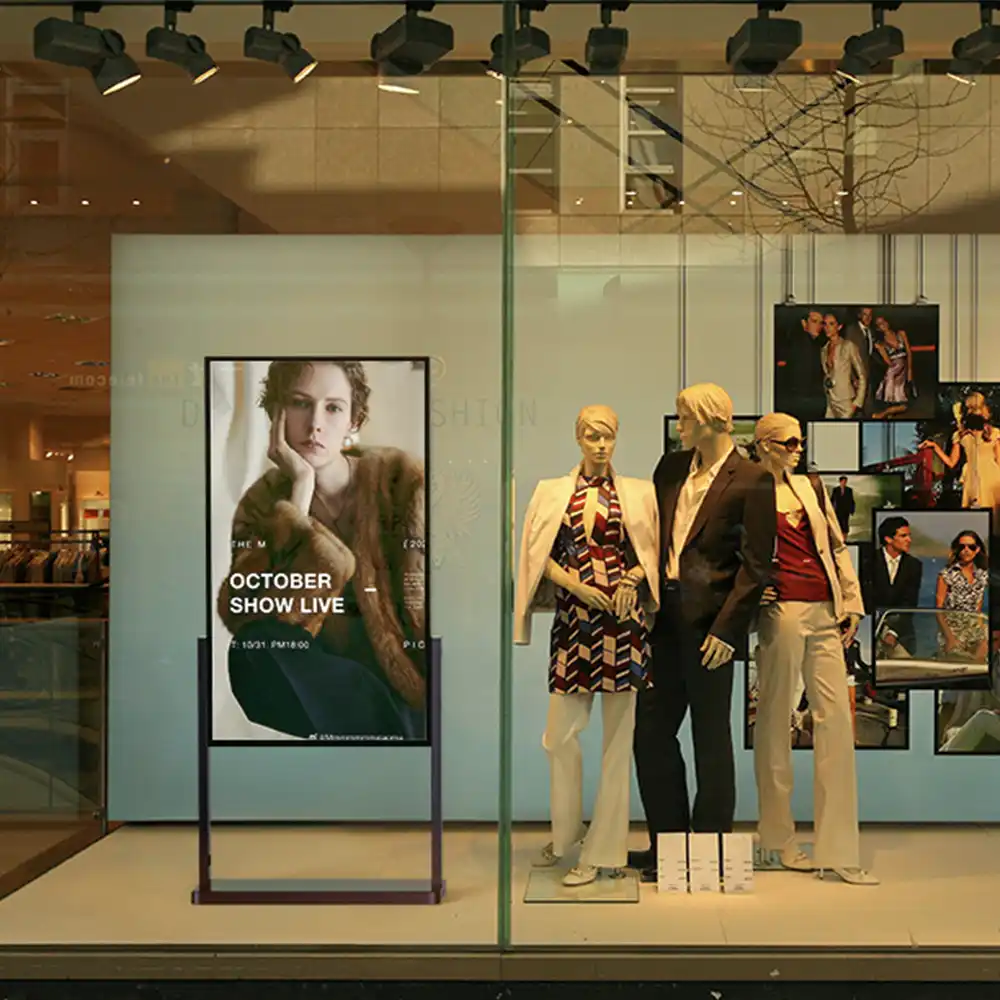
- Retail: price tags, promotional posters, window displays
- Public facilities: Orientation systems, emergency exit signs, event notices
- Catering: menus, table displays, promotional notices
What is digital signage?
Digital signage refers to the use of digital displays, steles, and interactive systems for displaying and controlling information, advertising, or directions. The content is managed centrally via software and can be updated flexibly, across locations, and in real time. Digital signage is used in a wide variety of areas—from retail to businesses, restaurants, and hotels to public institutions and transportation hubs.
Typical components:
- Displays (LCD, LED, OLED, e-paper) – indoor and outdoor
- Media players or integrated systems
- Content management software (CMS) for central control and planning
- Network and power connection
- Optional: touch function, sensors, camera, speaker for interactive applications
Advantages of traditional signage
Proven technology and easy handling
Classic signs are easy to install, require no power supply, and operate independently of networks or software. They are robust, durable, and low-maintenance.
Low initial costs
For small businesses or institutions with little information that rarely changes, traditional signs may be cheaper to purchase.
No dependence on electricity, software, or IT skills—traditional signage always works, even during power outages or technical problems.
Disadvantages of traditional signage
Limited flexibility
Changes require manual replacement or new production—which costs time, money, and often causes logistical effort.
Limited attention and design options
Static signs offer little scope for creative, attention-grabbing designs. They cannot display moving images, changing content, or interactive elements.
Higher follow-up costs for frequent changes
If information is updated regularly (e.g., room reservations, offers, events), printing and replacement costs quickly add up.
Limited reach and target group appeal
Analog signs are always the same and cannot be adapted to the time of day, target group, or location.
Advantages of digital signage
Maximum flexibility and up-to-date information
With digital signage, content can be centrally controlled and updated in real time at any time—across locations and without media discontinuity. Promotions, notices, or offers can be adjusted in seconds.
Increased attention and reach
Moving images, brilliant colors, and animations attract significantly more attention than static signs. Content can be played out in a targeted manner and at specific times. Studies show that digital displays significantly increase perception and recall rates.
Interactive options
Touch displays and interactive kiosk systems enable self-service, product advice, directions, or individual searches for information—a real added value for visitors and customers.
Efficiency and sustainability
Digital signage reduces the effort required for printing, logistics, and manual updates. In the long term, costs are reduced because physical advertising materials no longer need to be produced. This is also a plus from an environmental perspective: less paper, less transport, less waste.
Modern brand image The use of digital communication solutions signals innovation and professionalism—an important factor in how your brand is perceived by customers, partners, and employees.
Central control and scalability
Whether it's a single display or a network with hundreds of screens, everything can be managed centrally. Ideal for companies with multiple locations or changing content.
Disadvantages of digital signage
Higher initial investment
The purchase of displays, software, and IT infrastructure involves higher investment costs than traditional signs. However, the investment usually pays for itself quickly if changes are made frequently or if there are multiple locations.
Technical requirements
Digital signage requires power, network access, and occasional maintenance. Basic IT knowledge or a service partner is recommended to ensure smooth operation.
Dependence on technology
In the event of a power failure or network problems, the display may be temporarily disrupted. However, modern systems often offer fallback solutions (e.g., temporary storage of content).
Digital signage vs. traditional signage: a direct comparison
| criterion | Traditional signage | digital signage |
|---|---|---|
| flexibility | Low | Very high |
| update | Manual, time-consuming | Centralized, in real time |
| design options | Restricted | Versatile, animated, interactive |
| attention | means | High |
| Costs (long-term) | Increasing with changes | Decreasing with frequent updates |
| interactivity | None | Possible (touch, information terminals) |
| image factor | Classic | Modern, innovative |
| dependence on technology | None | Yes (power, network, software) |
| sustainability | Paper, plastic | Less waste, less consumption |
| scalability | Limited | Very high |
Practical examples: Who benefits most from digital signage?
Retail:
Daily specials, window displays, product videos, and customer stoppers can be adjusted in real time, increasing flexibility and advertising impact.
Business & Administration:
Digital signage, room occupancy displays, reception displays, and internal information screens ensure better orientation and faster communication.
Catering & hospitality:
Menu boards, event notices, and guest information can be flexibly customized, and seasonal promotions or changes are immediately visible.
Healthcare:
Waiting room TVs, patient call systems, and wayfinding aids improve the service experience and efficiency.
Public institutions & transportation:
Weatherproof outdoor displays provide information about schedules, emergencies, or events—always up to date, even in changing conditions.
Who can benefit from digital signage?
Digital signage is worthwhile for all companies and organizations that regularly update information, operate multiple locations, value modern brand communication, or want to communicate interactively with their target groups. Digital solutions offer significant advantages over traditional signage, especially in retail, businesses, public institutions, healthcare, and transportation. Scalable systems and falling costs also make it attractive for small businesses to get started.
Tips for decision-making
- Analyze your requirements: How often does your content change? How many locations or areas do you want to cover?
- Consider your image: Do you want to present yourself as modern, innovative, and flexible?
- Calculate total costs: Consider not only the purchase price, but also follow-up costs for modifications, maintenance, and operation.
- Consider the future: scalability and expandability are significantly higher with digital signage.
- Consult with experts: An experienced partner can assist you with selection, design, and implementation.
Conclusion: Digital signage or traditional signage?
Both systems have their merits—depending on the application, budget, and objectives. However, those who value flexibility, efficiency, modern brand presence, and future-proof communication will benefit from digital signage in the long term. The investment pays off through lower follow-up costs, greater attention, and an innovative user experience. Traditional signage remains useful for permanent, rarely changing information or as a supplement to digital solutions.
FAQ – Frequently asked questions about digital signage and traditional signage
How much does it cost to switch from traditional signage to digital signage?
The costs depend on the scope of the installation, the hardware and software required, and the desired functions. While the initial costs are higher, the investment usually pays for itself through lower follow-up costs and greater efficiency—especially in cases involving frequent changes or multiple locations.
Do I need IT skills to use digital signage?
Many systems are intuitive to use and offer user-friendly interfaces. For more complex installations, we recommend working with a specialized partner.
Can I reuse existing content?
Yes, photos, videos, or graphics can usually be integrated directly into digital signage systems. In addition, much content can be automated (e.g., news, weather, social media).
How much maintenance does digital signage require?
Modern systems are low-maintenance and can often be monitored remotely. Regular software updates and occasional hardware checks ensure smooth operation.
Is digital signage also useful for small businesses?
Absolutely—even with just a few displays, information and offers can be presented professionally and flexibly. The systems are scalable and can be customized to suit individual needs.
What about sustainability and environmental friendliness?
Digital signage saves paper, reduces transport distances, and enables targeted, needs-based communication—this conserves resources and reduces the ecological footprint.
Are you considering switching to digital signage or looking for the right solution for your company?
Contact us for a no-obligation consultation—we will support you from planning to successful implementation!