Why is the choice of display technology crucial?
Display technology is at the heart of every digital signage solution. It influences not only image quality, brightness, and color reproduction, but also energy consumption, service life, possible applications, and costs. It is essential for resellers to understand the differences between and areas of application for the most important technologies in order to provide customers with optimal advice and offer them suitable systems.
The most important display technologies in digital signage
1. LCD (Liquid Crystal Display)
LCD is the most widely used technology for digital signage, both indoors and in semi-outdoor areas.
Functionality
- Liquid crystals are aligned by electrical voltage and control how much light is transmitted by the backlight.
- Color filters create the color image.
benefits
- High resolution and brilliant color reproduction
- Relatively low power consumption
- Wide range of sizes and formats (from 10" to over 100")
- Good value for money
disadvantages
- Limited brightness (depending on model)
- Black level and contrast lower than with OLED
- Viewing angle dependency in low-cost models
2. LED (Light Emitting Diode)
LED displays are the first choice, especially for outdoor and large-format applications (LED walls).
Functionality
- The image is generated directly by individual light-emitting diodes (LEDs).
- There is no backlighting—each LED is self-illuminating.
- Pixel pitch (distance between LEDs) determines resolution and viewing distance.
benefits
- Extremely high brightness (up to 10,000 nits and more)
- Any sizes and formats (modular design)
- Very robust, weather-resistant, and durable
- High contrast, even in daylight
disadvantages
- Visible pixel structure at close viewing distance (depending on pixel pitch)
- Higher power consumption at maximum brightness
- Lower color depth and resolution compared to high-quality LCDs for small areas
3. OLED (Organic Light Emitting Diode)
OLED is a premium technology for demanding indoor applications.
Functionality
- Each subpixel cell illuminates independently and can be switched on or off individually.
- There is no backlighting.
benefits
- Perfect black, very high contrast
- Brilliant, rich colors
- Extremely thin and flexible design possible
- Wide viewing angle
disadvantages
- Begrenzte maximale Helligkeit (meist < 1.000 Nits)
- More expensive than LCD and LED
- Image retention possible with static content
4. MicroLED
MicroLED is a still young but forward-looking technology for high-end applications.
How it works:
- Similar to classic LEDs, but with extremely small, individually addressable LEDs.
- Each LED is self-illuminating, resulting in very high brightness, brilliant contrast, and excellent color reproduction.
Advantages:
- Very high brightness (up to 5,000 nits and more)
- Excellent contrast and color gamut
- No burn-in effects as with OLED
- Long service life, low maintenance requirements
- Modular design for any size and shape
Disadvantages:
- Still very expensive and difficult to obtain
- Previously mainly suitable for large installations and premium projects
5. E-paper (electronic paper)
E-paper is an energy-saving technology that is primarily used for digital door signs, timetables, and information displays.
How it works:
- Reflects ambient light like paper, only requires power when changing images.
- No backlight, therefore very easy on the eyes.
Advantages:
- Extremely low power consumption
- Best readability in daylight, even outdoors
- No annoying reflections or glare
Disadvantages:
- No moving images or videos possible
- Limited color representation (mostly black and white or few colors)
- Low refresh rate
6. Projection
Projection solutions (e.g., laser beamers) are used for special requirements, such as large, temporary surfaces or unusual formats.
Advantages:
- Very large screen sizes possible
- Flexible installation options (e.g., on glass, facades, floors)
- No visible display edges
Disadvantages:
- Lower brightness than LED/LCD in daylight
- Dependence on room lighting and projection surface
- Regular maintenance (e.g., lamp replacement) required
Comparison of display technologies by area of application
| technology | indoor | Semi-outdoor | Outdoors | Interactive | Large format/wall |
|---|---|---|---|---|---|
| LCD | ✓✓✓ | ✓✓ | (✓) | ✓✓✓ | ✓ (video wall) |
| LED | ✓ | ✓✓ | ✓✓✓ | ✓ | ✓✓✓ |
| OLED | ✓✓✓ | (✓) | – | ✓✓✓ | ✓ (Premium) |
| MicroLED | ✓✓ | ✓✓ | ✓✓✓ | ✓✓ | ✓✓✓ |
| e-paper | ✓✓ | ✓✓ | ✓✓ | – | – |
| projection | ✓✓ | (✓) | – | ✓ | ✓✓✓ |
✓ = suitable, ✓✓ = very suitable, ✓✓✓ = optimal, (✓) = limited suitability, – = not suitable
Important criteria for selecting display technology
1. Location and environmental conditions
- Indoor: LCD, OLED, MicroLED, e-paper; projection for special cases
- Semi-outdoor: high-brightness LCD, LED, MicroLED, e-paper
- Outdoor: LED, MicroLED, special outdoor LCDs, e-paper for static content
2. Lighting conditions and brightness
- Bright environment/sunlight: LED, MicroLED, high-brightness LCD, e-paper
- Dimmed rooms: OLED, standard LCD, projection
3. Content and use
- Moving image/video: LCD, LED, OLED, MicroLED, projection
- Static content/text: E-paper, LCD, LED
- Interactivity: LCD, OLED, MicroLED (touch functionality possible)
4. Size and format
- Small formats (10–32″): LCD, OLED, e-paper
- Medium to large formats (32–110″): LCD, OLED, MicroLED
- Very large surfaces/walls: LED, MicroLED, projection
5. Budget and service life
- Budget-friendly: Standard LCD, e-paper
- Premium segment: OLED, MicroLED, special LED walls
Practical examples: The right technology for different applications
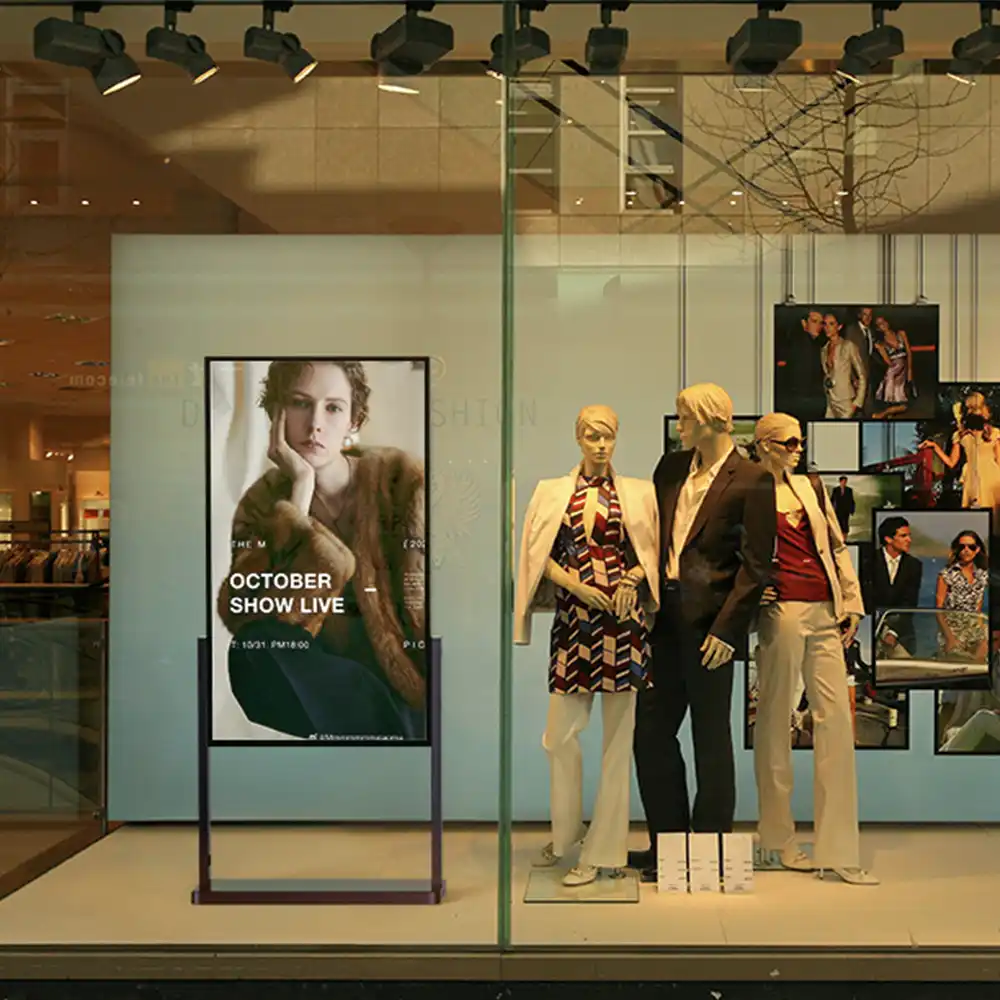
Retail – Shop window display
Requirement: Maximum visibility in daylight, changing content, advertising impact
Recommendation: High-brightness LCD (2,000+ nits) or fine-pitch LED
Reason: LCD offers brilliant colors and high resolution, while LED scores points for very large formats and extreme brightness.
Corporate lobby – Interactive information terminal
Requirements: Touch function, brilliant image, elegant appearance
Recommendation: LCD or OLED touch display, possibly MicroLED for premium solutions
Reason: LCD is robust and versatile, while OLED impresses with excellent color reproduction and a slim design.
Outdoor advertising wall – large format, long-distance effect
Requirements: Weatherproof, high brightness, large display area, changing content
Recommendation: LED wall (pixel pitch depending on distance), MicroLED for high-end
Reason: LED is modular, extremely bright, and durable—ideal for outdoor use and long-distance viewing.
Digital door signs or timetables
Requirements: Energy efficient, optimal readability in daylight, infrequent updates
Recommendation: E-paper
Reason: E-paper only consumes power when images change, is non-reflective, and is ideal for static information.
Common mistakes when choosing technology
- Incorrect brightness: Displays that are too dark for bright environments or too bright for darkened rooms.
- Unsuitable technology for outdoor use: standard LCDs without weather protection or insufficient brightness.
- Neglecting resolution: Pixel pitch too coarse for LED walls at short viewing distances.
- Inappropriate content type: Moving images on e-paper or projection in bright ambient light.
- Inappropriate interactivity: No touch for self-service applications or touch for unsuitable display types.
Consulting guide: How to find the right technology
- Analyze the location and environmental conditions
- Indoor, semi-outdoor, outdoor
- Lighting conditions (daylight, artificial light, shadows)
- Define the purpose and content
- Video, animation, static information, interactivity
- Determine size and viewing distance
- Small format, large format, long-range effect, close range
- Consider budget and service life
- Acquisition costs, operating costs, maintenance
- Technical requirements and additional features
- Touch, brightness control, anti-glare, temperature management
- Future-proofing and scalability
- Modularity, expansion options, spare parts availability
Checklist for resellers: The most important points about display technology
- Location and lighting conditions analyzed
- Appropriate technology (LCD, LED, OLED, MicroLED, e-paper, projection) selected
- Brightness and contrast tailored to the application
- Resolution and pixel pitch selected according to viewing distance
- Interactivity and content type taken into account
- Budget and follow-up costs calculated
- Customers informed about the advantages and disadvantages of the technologies
- Test operation or reference projects recommended
FAQ – Frequently asked questions about display technology for digital signage
Which display technology is best suited for shop windows?
High-brightness LCDs (2,000–4,000 nits) or fine-pitch LEDs offer the best visibility in daylight and brilliant colors.
Can I use OLED displays outdoors?
OLED is not suitable for outdoor applications because the maximum brightness is too low and the technology is sensitive to UV light and moisture.
When does e-paper make sense?
E-paper is suitable for static information such as door signs, timetables, or price labels, especially when power consumption and readability are key considerations.
How do I choose the right pixel pitch for LED walls?
Rule of thumb: Minimum viewing distance in meters ≈ 1.5 x pixel pitch (in mm). For a distance of 6 meters, a pixel pitch of 4 mm is recommended, for example.
Are there any technologies that are particularly durable?
LED and MicroLED displays offer a very long service life and are particularly robust—ideal for demanding and permanent installations.
Conclusion:
Choosing the right display technology is crucial to the success of any digital signage project. With in-depth knowledge, systematic advice, and a focus on individual requirements, resellers can help their customers find the optimal solution—for maximum visibility, efficiency, and investment security.
Would you like individual technology consulting or further training for your sales team?
Contact us—we will support you with expertise, workshops, and customized digital signage solutions!